Showing posts with label Monique Saigal. Show all posts

Sunday, July 15, 2018

Summer Reading 2018

impression
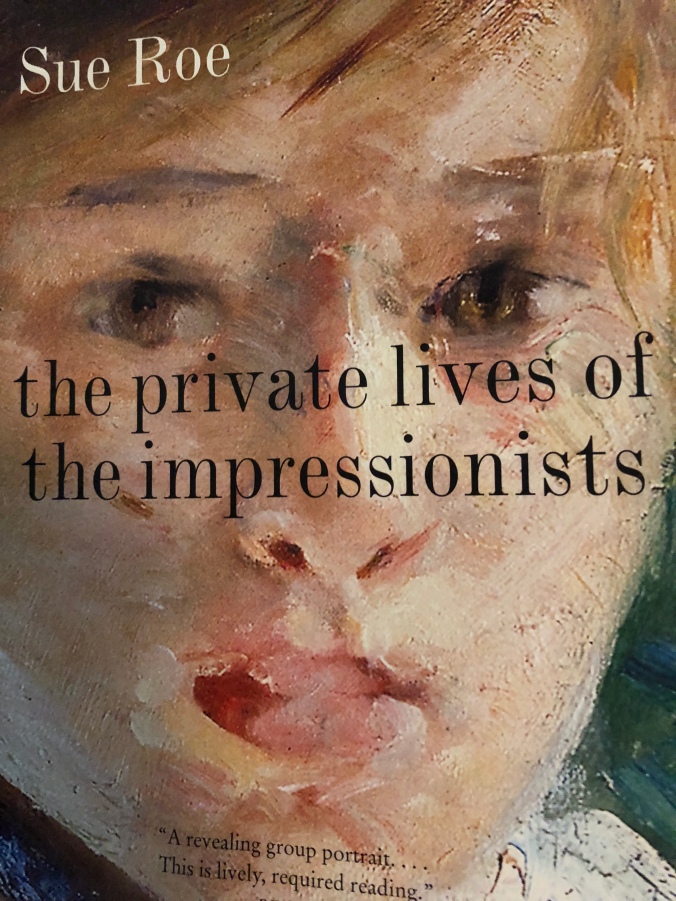
This is what I am currently reading. A former student who is now one of my beloved colleagues gave it to me this spring. I think she found it at our annual book fair, one of my favorite school-related events. It is a great read- kind of like peeking in the window and watching Renoir, Monet, Degas, Cézanne, Pissarro, Sisley, Manet (although he did not want to identify as an Impressionist), Morisot and Cassatt in their studios. They were so unappreciated (that is an understatement) and many of them struggled to make ends meet and provide for their families. Roe decided to write this book and concentrate on the 26 years, 1860-1886, between their first encounters with each other and 1886 when Parisian art dealer Paul Durand-Ruel got on a boat with 300 of their paintings and set sail for New York City. I even discovered that Monet briefly set up residence at the Hôtel Londres et New York, across from the Gare St. Lazare, the hotel where I stay with my students every March. Quelle coïncidence.
I have finished my faculty summer reading book.
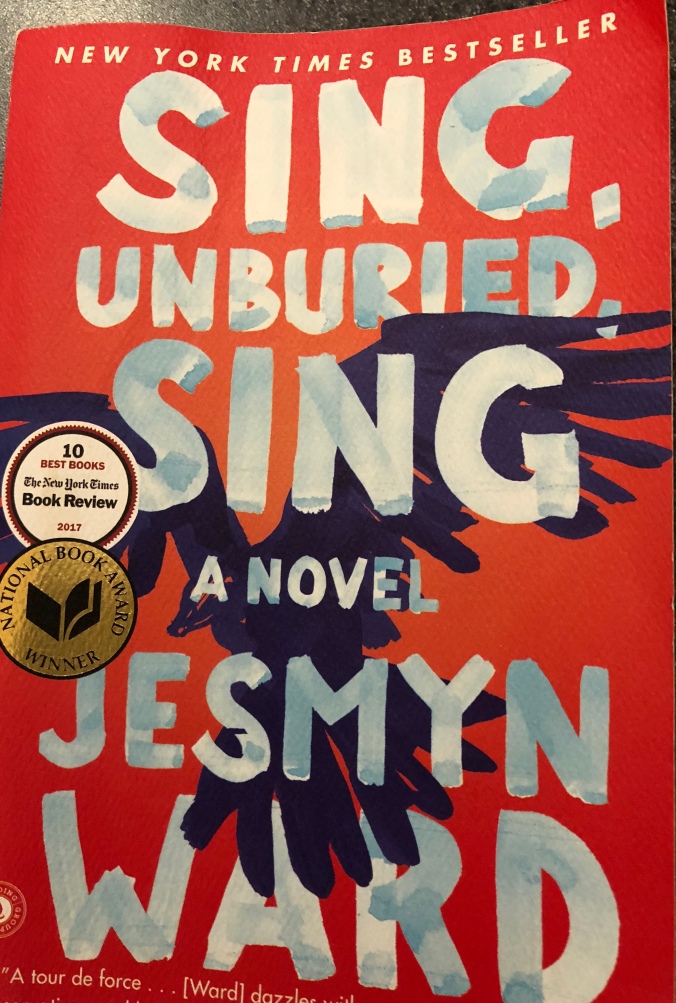
sing
Each spring, we are asked to “nominate” books we think are valuable to read and then when the list is pared down, we choose our book. When school starts back in August, we will have book discussions. Another reason to love my school. I couldn’t put this book down although it was very disturbing. The hardships of a young mixed race boy, Jojo, and his family in Mississippi isn’t necessarily “pretty” reading. Throw in Parchman, the state penitentiary, white racist grandparents, a drug addict mother, a grandmother dying of cancer, and family members who can see and hear the unsettled dead and it is pretty intense reading.
Love and Ruin by Paula McLain is the story of Ernest Hemingway and Martha Gellhorn. She was a war correspondant and Hemingway’s third wife. A great read. I wasn’t sure that I would like it after falling in love with Hadley, Hemingway’s first wife, while reading The Paris Wife also by McLain. I now have an immense amount of respect for Gellhorn and her courage.
This Dark Road to Mercy by Wiley Cash is set in North Carolina and is the story of two little girls, living in an orphanage since the death of their drug-addicted mom. Their father comes to get them and they have quite an adventure. Dangerous and dark at times. Throw in some baseball and it is a great story. I have enjoyed all of Cash’s books. He is a good North Carolina boy and I especially love him for that.
I indulged in Nicholas Sparks’ Two by Two while at the beach with Sister Moo and Best Niece. Who doesn’t need a quick read like this once in a while? A man who learns how to be a single dad and take care of his Barbie doll-loving daughter while coping with a wife who no longer loves him and for whom he has never been a good enough husband.
The Chocolate War by Martin Walker is a short story starring Bruno, chief of police in a small village in southern France. I have a huge crush on Bruno and have loved all of the mysteries he has solved.
Charles Salzberg is a writer I have gotten to know a bit through Facebook and email. Second Story Man is his latest and I couldn’t put it down- which meant reading way past my bedtime a couple of nights. “Francis Hoyt, arrogant, athletic, brilliant, manipulative and ruthless, is a master burglar.” That line alone should hook you. I would love to attend Charles’ New York Writers Workshop someday…
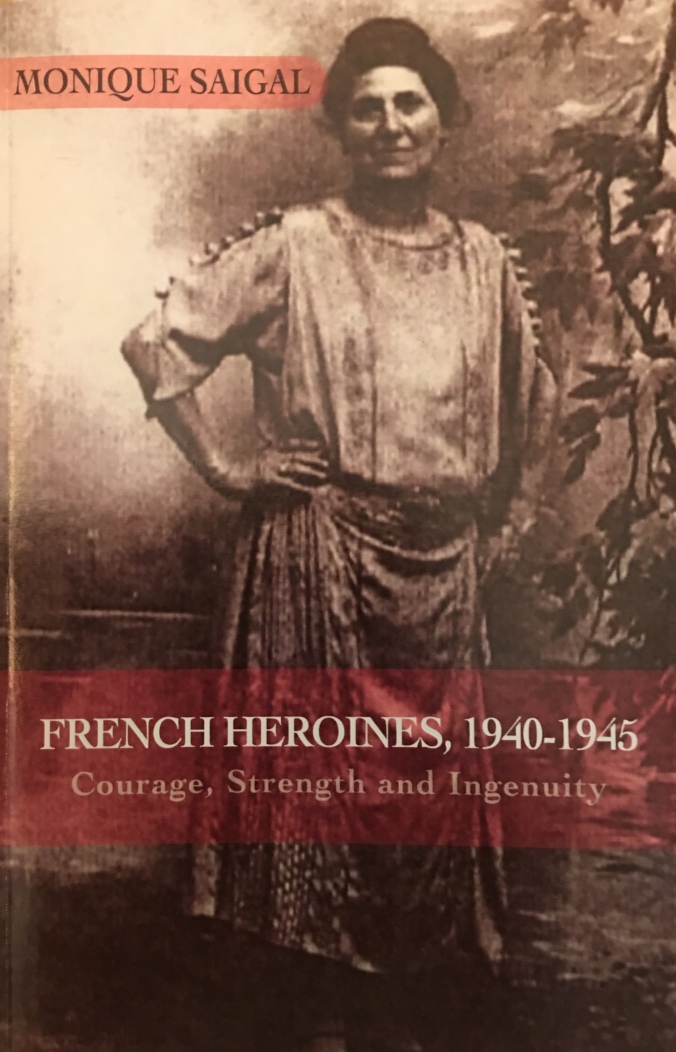
The Alice Network by Kate Quinn tops the list of books I have recently read. It is the story of a woman recruited as a spy during WWI and an American who is searching for her lost cousin in 1947. The novel is set in France and takes the reader back and forth between the two wars and the story of amazing women doing what they could to help their country win the war. This is subject that I can’t seem to read enough about these days. Meeting Monique Saigal while in Paris in Marchlistening to her story, and then reading her book, French Heroines, 1940-1945, were life changing experiences for me. At the age of 3, Monique was put on a train by her Jewish grandmother to get her out of Paris and to a safer place in the southwest France during WWII. Monique was taken in by a young woman and her father and given a new identity, that of a Catholic child, for nine years. Her grandmother died at Auschwitz one month after putting Monique on that fateful train. Many thanks to Niece M for pointing me towards The Alice Network. She read it for a book club organized by someone at her workplace.
I have a couple of books waiting in the wings (in addition to a couple of books on designing curriculum…).
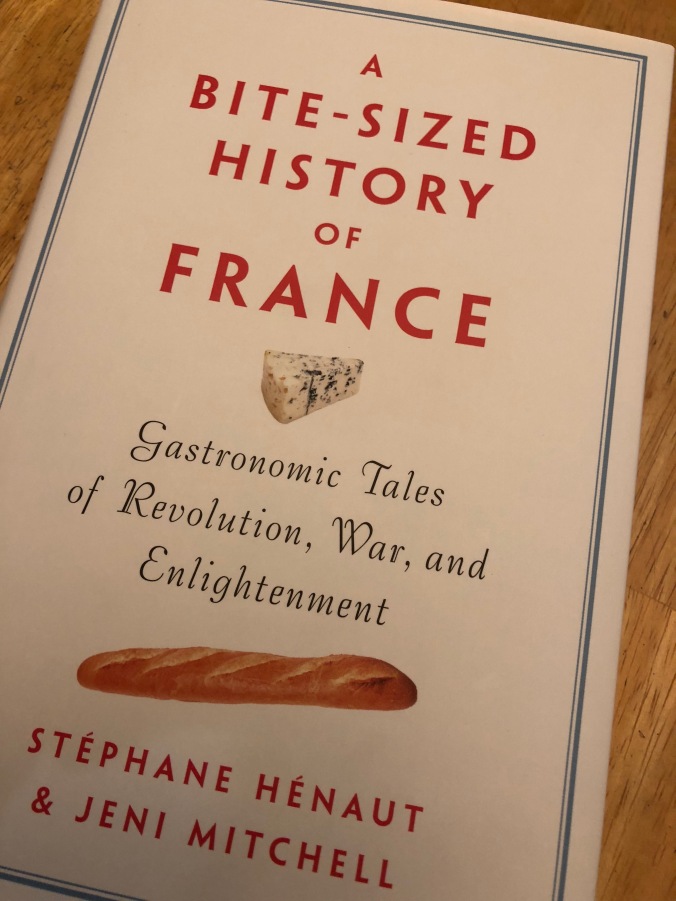
french food
I found this one at Flyleaf Books in Chapel Hill while waiting to have a delicious dinner next door at Kitchen with Mme M. Looks good, n’est-ce pas? I love Flyleaf. And books about eating.
And last, but not least, on my list at the moment is Ann Mah‘s latest book, released in June, The Lost Vintage. I am a big Ann fan. I learned quite a bit while reading Mastering the Art of French Eating. Ann even sent me a signed book plate for my book. Her newsletters are always full of great information and her website includes recipes. The sure way to my heart.
So there you have it. Not a complete list, but definitely the highlights. Reading is one of my greatest passions. Mlle Adorable, my 16-month-old granddaughter, is already showing signs of being an avid reader When she comes to visit, she heads straight for her stack of books. This is my favorite photo of her and Granddad, taken a couple of weeks ago at Sunset Beach.
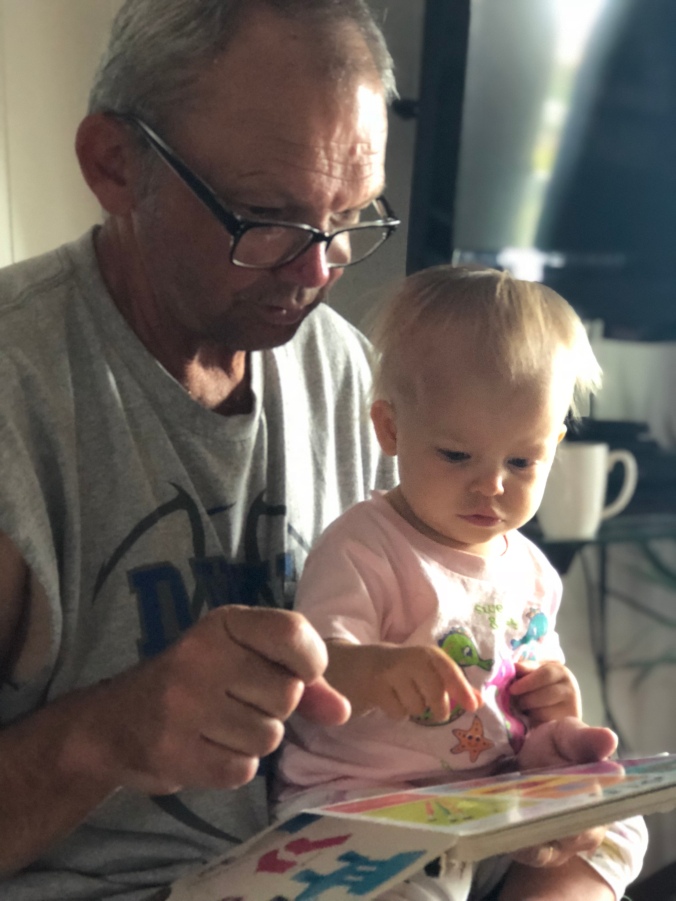
K and gdad
Bon appétit! “Reading can seriously damage your ignorance.” Spread the word and keep reading. If you have any suggestions, please leave a comment!

Sunday, April 29, 2018

The right place at the right time

JLAP
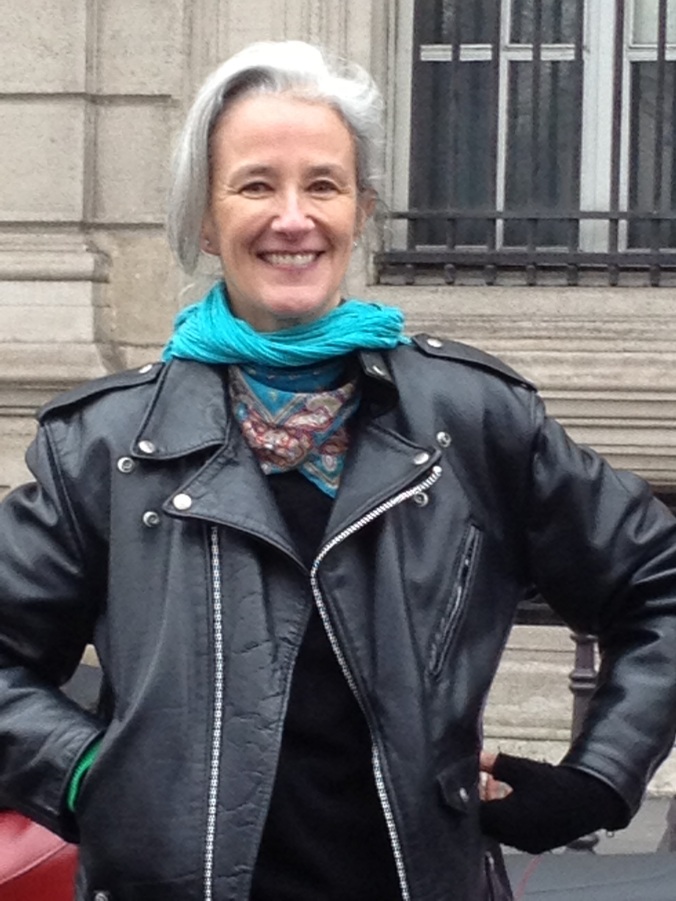
It has only been a little over a month since I returned from France. It was an amazing trip with my co-chaperone and 13 of my eighth grade students. While planning the trip, I discovered that there would be a guided tour in English at the Mémorial de la Shoah. My students and I discuss the Holocaust and La Rafle, the round-up of the Jews in Paris in July of 1942. I show them the movie Sarah’s Key, based on the novel by Tatiana de Rosnay. I have had the pleasure of meeting Mme de Rosnay twice, once by design, once purely by chance. Being in the right place at the right time. In front of the Paris Hôtel de Ville during a rally for women in 2013. She was the guest of honor. All of the women were on motorcycles, including Mme de Rosnay.
tatiana
I’ve been to the Mémorial de la Shoah several times in the past few years. While in Paris in January of this year, I decided to visit Drancy, the site of one of the deportation camps used during the Holocaust. I have read stories of women who survived the camps or who were hidden children during the Holocaust. I have also read fictionalized accounts of the occupation of France by the Nazis such as All the Light We Cannot See by Anthony Doerr and The Nightingale by Kristin Hannah. My high school French teacher, Mme Christiane Roze Buchanan, lived in occupied France.
IG
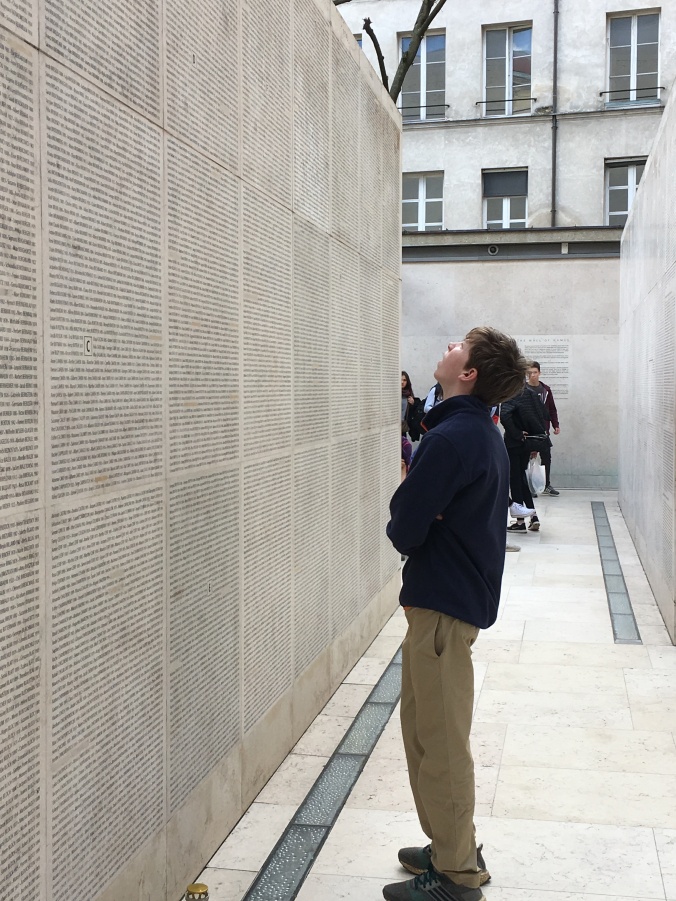
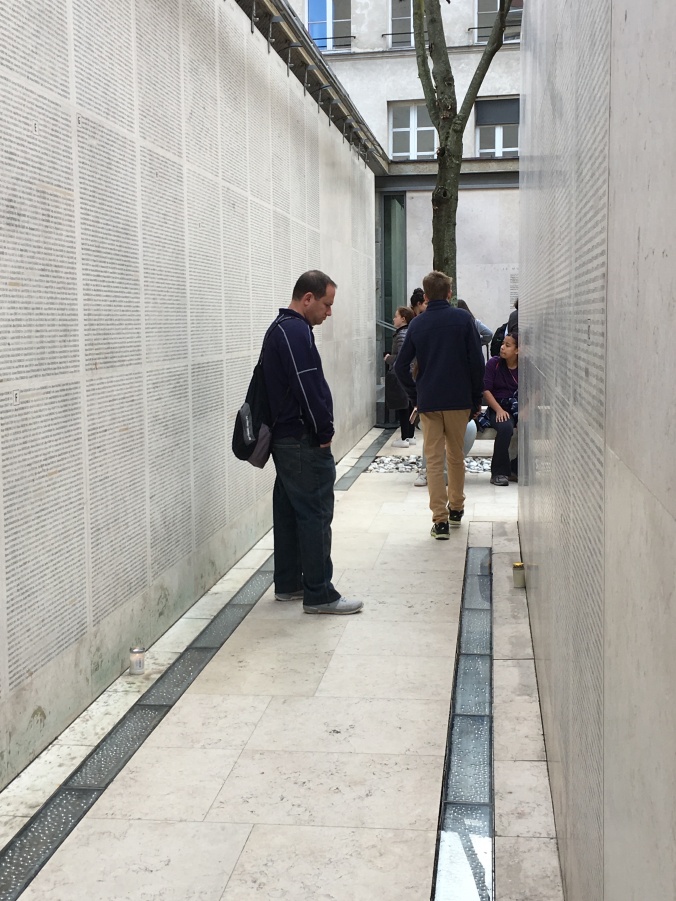
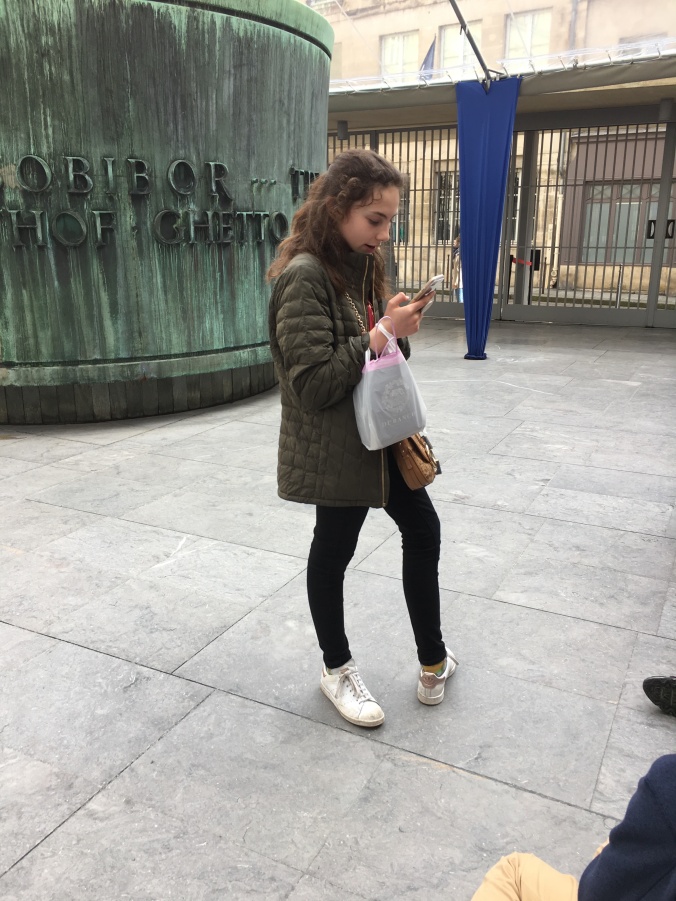
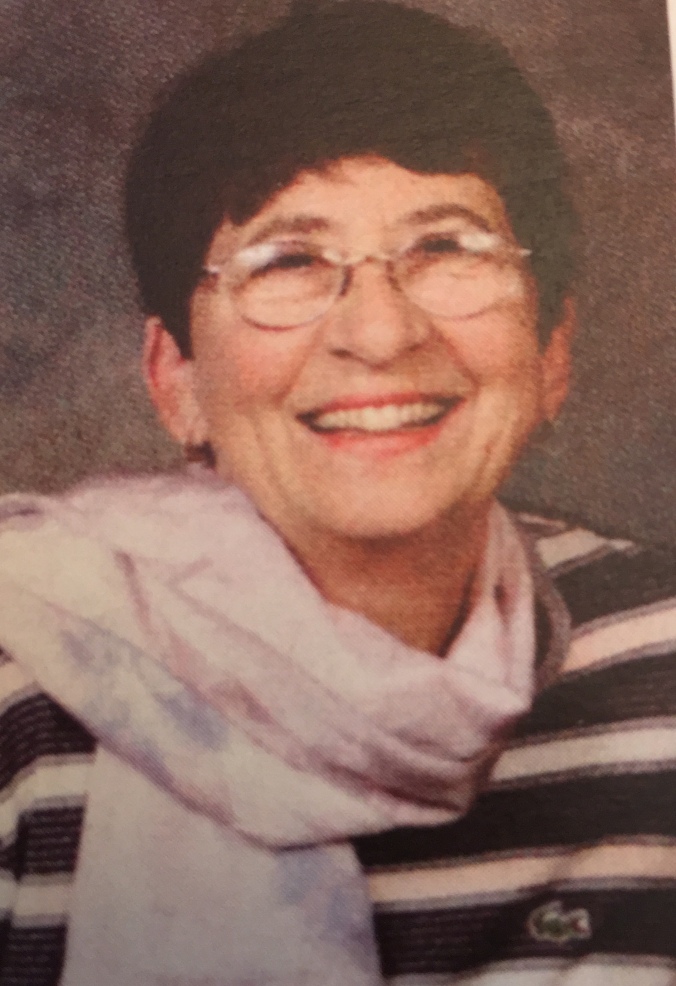
On this particular March Sunday afternoon, I arrived with my crew in time for one young lady, who became a Bat Mitzvah in November of 2018, to make a presentation about the Mémorial. (I ask all of the students to sign up for one of the places we will visit and prepare a short presentation about it.) We also had time to take a look at the Wall of Names before our guided tour began (see first two photos). We found a place to sit inside the Mémorial to wait on our guide. There weren’t many places to sit and when another woman came over to join our group, I gave one young man a look that meant “Get up and give your seat to this woman. Now.” He read me well and got up. This woman struck up a conversation with the students she was sitting next to– Where are you from? Why are you in Paris? What have you seen so far? Then the tour began and we took a two-hour journey through the history of anti-semitism and anti-Judaism in France. The tour ended in a relatively small room, with just a few glass benches, and black and white photos of children on the walls. Photos of children taken from their families during the Holocaust. By this time, I was in tears. Just thinking of having my children or granddaughter taken from me is almost more than I can stand. As I sat there, I heard a voice behind me say in French to the guide “J’étais un enfant caché.” I was a hidden child. The voice came from the woman who had joined our tour. The guide asked her in French if she would be willing to share her story. The right place at the right time.
(I am taking this from Monique’s bio- she tells the story much better than I could.)
monique's book
A “hidden child” of the Holocaust taken in France in 1942, Monique Saigal dedicates the new edition of her book to her grandmother Rivka Leiba pictured on the cover, gassed at Auschwitz September 30th, 1942. A month earlier, on August 24th fearing for Monique’s life she threw her on a train carrying non-Jewish children whose fathers like Monique’s had died. An organization called “the house of the prisoners” helped war widows by sending their children to spend a one month vacation with a host family in Southwest France. Scared and alone, Monique arrived at the train station but there was no one to pick her up. However, a young lady Jacqueline Baleste, waiting for a little boy who did not come off the train, saw the little girl with no name-tag crying in the corner. She embraced her and brought her home where Monique lived with the Baleste family for 8 years in a small village. She was baptized and raised Catholic for fear of surrounding Nazis in this occupied zone.
monique photo
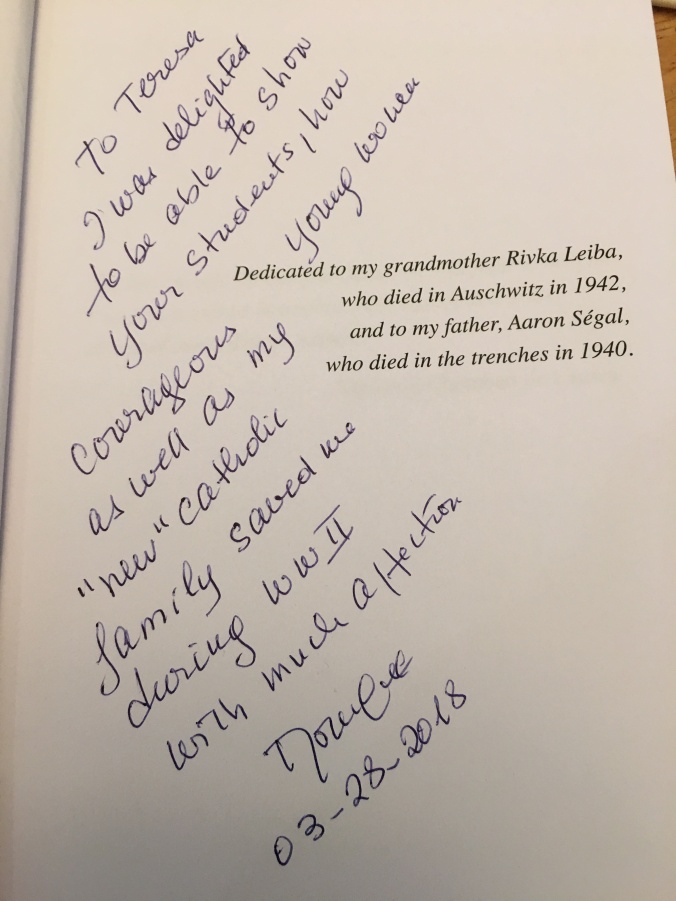
After she spoke with the group, Monique gave me a postcard-sized card with her bio. And her email address. I attempted to wipe away my tears and hugged her. Later that evening, I emailed Monique to thank her for sharing her story with us. She quickly emailed back and told me that she would be happy to meet us and share more of her story if we had the time. We settled on a time, she came to our hotel with her power point presentation on her computer, and told us more of her story. Several of my students bought a copy of her book. When she ran out of copies, she told me that she would send some more to me as soon as she got back to California. (She was in Paris to visit her uncle, her mother’s brother.)
monique's inscription
Monique’s book, French Heroines, 1940-1945, available in both French and English, contains the stories of women “who are little known yet who stand out because of their extraordinary courage during the German occupation in World War II, when they risked their lives, engaging in clandestine activities to overcome the Nazis.” There are eighteen stories because in Hebrew “chai” or the number 18 stands for life. I read these eighteen stories and have even reread most of them because their acts of bravery seem unbelievable to someone who spends most of her time worrying about “first world problems.”  I want to believe that I would have been one of those brave women. But I hope that I never have to find out the limits of my bravery and courage.
Merci, Monique. I will never forget our chance encounter. Thank you for being so very brave. God bless your grandmother and the Baleste family.
The right place at the right time. How very fortunate I am.
As I read about the people who were starving during the war, I realized that although my family didn’t have very much money when I was growing up, Mama Mildred always managed to put food on the table for her four children. I made a very simple soup today and I will pass that recipe on. My recipes such as this one are always a guess-timate, as we say in English. Soups do not have to be exact. That’s probably one of the reasons I enjoy creating them. Someone left a bag of Wegman’s Salt Potatoes in the faculty lounge this week and I claimed them. A 5-pound bag of potatoes with a small bag of salt inside. Go figure!
soup
Potato Sausage Soup
Andouille sausage, cut in bite-sized pieces
1 medium or large onion, diced
Minced garlic, optional
Olive oil
Thin-skinned potatoes, scrubbed (and peeled, if you wish), cut into bite-sized pieces
Chicken stock or broth (you could also use vegetable stock or even water)
Herbs (I used Weber’s Roasted Garlic and Herb Seasoning)
Salt and pepper, if desired
In a heavy bottomed pot, heat olive oil over medium high heat. Brown the sausage on both sides. Remove to a bowl and set aside.
Using the same pot and oil, sauté the onions until soft. If using minced garlic, add it at the end, for about 2 minutes, stirring with a wooden spoon.
Put the potatoes in the pot with the onions. Cover the potatoes with chicken stock, broth or water. Add back the sausage. Sprinkle in herbs. Stir. Cover and bring to a boil. Reduce heat and simmer until the potatoes are tender. Taste and adjust seasonings, if needed.
Bon appétit to heroes from all walks of life. Big and small. Rich and poor. Old and young. Jewish, Catholic, Protestant or non-believers. And all in-between. To all who perform intentional and/or random acts of kindness in this world. And remember, everyone has a story. We just need to open our hearts and ears and listen. Really listen.